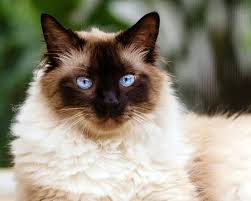
The Himalayan (short for Himalayan Persian Persian as it is commonly, or Colourpoint
referred to in Europe), is a breed or sub-breed of long-haired cat similar in type to
the Persian, with the exception of its blue eyes and its point coloration, which were derived from crossing the Persian with the
Siamese. Some registries may classify the Himalayan as a long-haired sub-breed of
Siamese, or a colourpoint sub-breed of Persian. The World Cat Federation
has merged them with the Colourpoint Shorthair and Javanese Cat into a single breed, the Colourpoint.
History
See Also: Persian Cat
Work to formally establish a breed with combined Persian and Siamese traits, explicitly for
the cat fancy, began in the United States in the 1930s at Harvard University, under the term Siamese–Persian, and the results were published
in the Journal of Heredity in 1936, but were not adopted as a recognised breed by any major fancier groups at the time.
Brian Sterling-Webb independently developed the cross-breed over a period of ten years in the UK, and in 1955 it was recognised there as the Longhaired Colourpoint by the Governing Council of the Cat Fancy (GCCF).
Cat breeder Jean Mill from California, US, took a series of graduate classes in genetics at the
University of California, Davis.
By 1948, she was one of three breeders independently crossing the Persian and Siamese to create the Himalayan cat.
Separate US-based breeding efforts had begun around 1950, and a breeder known to sources simply as Mrs. Goforth received breed recognition from the
Cat Fanciers' Association (CFA) near the end of 1957 for the Himalayan
Early breeders were mostly interested in adding Siamese coloration to long-haired cats, and therefore reinforced the stock by outbreeding to Persians only to retain the Persian trait dominance.
However, by the 1960s, some were re-introducing Siamese stock and producing less "Persian-style" cats.
In the 1980s, a concerted effort to re-establish the breed along more formally Persian lines ultimately caused the breed to be merged into Persian as a variant in some registries
(e.g. in 1984 by CFA), and a decline in the "old" or Siamese-like specimens.
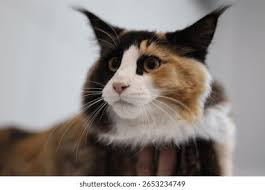
The Maine Coon is a large domesticated cat breed. The breed is selectively bred from one of the oldest landraces in North America, and is pedigreed in all major cat registries worldwide.
It originated in the U.S. state of Maine, where it is the official state cat. The Maine Coon is a large and social cat, commonly referred to as "the gentle giant."
The breed is predominantly known for its large size and long, dense coat of fur which helps it survive in the harsh climate of Maine.
The Maine Coon is often cited as having "dog-like" characteristics.
The breed was popular in cat shows in the late 19th century, but its existence became threatened when long-haired breeds from overseas were introduced in the early 20th century.
The Maine Coon has since made a comeback, and is the most popular cat breed in multiple global cat registries.
History and Myths
Maine Coon cats are known to have originated in Maine. However, their lineage is surrounded by mystery, folk tales, and myths.
One myth claims that the Maine Coon cat is a hybrid with another animal species, such as the raccoon or bobcat.
Another myth suggests that the cats are descendants of Viking ship's cats, known today as the Norwegian Forest cats.
A third story involves Marie Antoinette, the Queen of France who was executed in 1793.
According to this tale, before her death, Antoinette attempted to escape from France with the help of Captain Samuel Clough, loading his ship with her most prized possessions,
including six of her favorite Turkish Angora or possibly Siberian cats. Although she did not reach the United States, her pets supposedly arrived safely at Wiscasset, Maine,
where they bred with other short-haired cats and contributed to the development of the modern Maine Coon breed.
Science
These myths and theories have long speculated that the long-haired Maine Coon cat has to be related to other long-haired breeds, due to their similarities in phenotype. This is true for
the Maine Coon in particular, that it is descended from the Siberian or Norwegian Forest Cat, brought to New England by settlers or Vikings. Phylogenetic studies showed that the Maine Coon
belongs to the Western European monophyletic cat branch, but forms the closest relationship with the random-bred cat population in the Northeastern US (New York region).
This Western European branch contains the Siberian and Norwegian Forest cat, but they fall under a different sub-branch. Maine Coons are descendants of cats brought to New England, US,
by Puritan settlers from the UK in the 1600-1700s, and out of the European cats they are genetically closest to cats found in the United Kingdom.
It is not relatedness that makes them look similar to the Siberian and Norwegian Forest cats, but convergent evolution. These breeds all formed in harsh climates, in which
natural selection pressures for similar qualities. Thick, long coats, toe and ear tufts, big bodies, and snowshoe-like big feet are useful traits in all the harsh climates where these breeds originate.
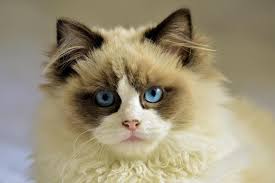
The Ragdoll is a breed of cat with a distinct colorpoint coat and blue eyes. Its morphology is large and weighty, and it has a semi-long and silky soft coat. American breeder Ann Baker developed Ragdolls in the 1960s.
They are best known for their docile, placid temperament and affectionate nature. The name Ragdoll is derived from the tendency to go limp and relaxed when picked up. The breed is particularly popular in both the
United Kingdom and the United States. Ragdolls are known as dog-like cats due to their tendency to follow people around, their receptiveness to handling, and their relative lack of aggression towards other pets.
Ragdolls are distinguishable by their pointed coloration (where the body is lighter than the face, ears, legs, and tail), large round blue eyes, soft, thick coats, thick limbs, long tails and soft bodies.
Their color rings are commonly tricolor or bicolor.
History
The breed was developed in Riverside, California, by a breeder named Ann Baker. In 1963, a regular, non-pedigreed, white domestic longhaired cat named Josephine produced several litters of typical cats.
Josephine was not of any particular breed, nor were the males who sired the original litters. Ann Baker herself said that the original cats of the Ragdoll breed were "alley cats".
Josephine later produced kittens with a docile, placid temperament, affectionate nature, and a tendency to go limp and relaxed when picked up.
Out of those early litters came Blackie, an all-black male, and Daddy Warbucks, a seal point with white feet. Daddy Warbucks sired the founding bi-color female Fugianna, and Blackie sired Buckwheat,
a dark brown-black Burmese-like female. Both Fugianna and Buckwheat were Josephine's daughters. All Ragdolls are descended from Baker's cats through matings of Daddy Warbucks to Fugianna and Buckwheat.
Baker, in an unusual move, spurned traditional cat breeding associations. She trademarked the name Ragdoll, set up her own registry-the International Ragdoll Cat Association (IRCA)-around 1971,
and enforced stringent standards on anyone who wanted to breed or sell cats under that name. The Ragdolls were also not allowed to be registered by other breed associations.
The IRCA is still in existence today but is quite small, particularly since Baker's death in 1997.
In 1975, a group led by a husband-and-wife team, Denny and Laura Dayton, broke ranks with the IRCA to gain mainstream recognition for the Ragdoll.
Beginning with a breeding pair of IRCA cats, this group eventually developed the Ragdoll standard currently accepted by major cat registries such as the CFA and the FIFe.
Around the time of the spread of the Ragdoll breed in America during the early 1960s, a breeding pair of Ragdolls was exported to the UK. Eight more cats followed this pair
to fully establish the breed in the UK, where the Governing Council of the Cat Fancy recognizes it.
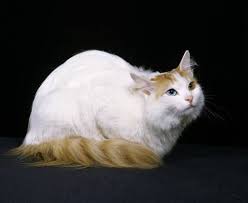
The Turkish Van is a semi-long-haired, standardised breed of domestic cat, which was developed during the 1950s the United Kingdom from a selection of cats obtained
from various cities of modern-day Turkey, especially southeast Turkey. This rare cat breed is one of the larger ones, and is distinguished by the Van pattern (named after the breed),
where the colour is restricted to the head and the tail, and the rest of the cat is white; this is due to the expression of the white spotting gene, a type of partial leucism.
A Turkish Van may have blue or orange eyes, or be odd-eyed (having one eye of each colour).
The breed was initially registered under the name Turkish cat in 1969 by UK-based Governing Council of the Cat Fancy (GCCF). It was later renamed Turkish Van
to better distinguish it from the Turkish Angora breed. The Turkish Van has been claimed to be descended from (and is often confused with) the landrace of
usually solid white Van cats, mostly found near Lake Van, though one of the two original breeders' own writings indicate clearly that none of the
Turkish Van's foundation cats came from the Van area.
History
In 1955, two British photographers, Laura Lushington and Sonia Halliday, while on assignment in Turkey for the Turkish Ministry of Tourism,
were given two unrelated cats in Turkey, which Lushington took home with her and allowed to mate. When the offspring came out identical
to their parents - chalk white with dark tail and head markings - she set to establishing a standardised breed, originally named Turkish cat,
later Turkish Van, and having it recognised by the British cat fancy organizations. Lushington returned to Turkey to find another pair,
with the goal of breeding to the standard "three clear generations".
According to Lushington, her original imported cats were: Van Iskenderun Guzelli (female), a cat that came from Hatay Province, Iskenderun,
and Stambul Byzantium (male), a cat given by a hotel manager in Istanbul, both in 1955. Two later additions to the gene pool were
Antalya Anatolia (female), from the city of Antalya, and Burdur (male), from Burdur city, both in 1959. Lushington did not see Van city before 1963,
and only stayed there "for two days and two nights". It is unclear why the name "Turkish Van" was chosen, or why one of the original 1955 kittens was
named Van Iskenderun Guzelli, given their provenance. Of the founding 1955 pair, Lushington wrote, in 1977:
"I was first given a pair of Van kittens in 1955 while travelling in Turkey, and decided to bring them back to England, although touring by car and
mainly camping at the time - the fact that they survived in good condition showed up the great adaptability and intelligence of their breed in trying circumstances.
Experience showed that they bred absolutely true. They were not known in Britain at that time and, because they make such intelligent and charming pets,
I decided to try to establish the breed, and to have it recognised officially in Britain by the GCCF."
It is unclear whether Lushington was intending to imply that the Hatay and Istanbul kittens had originally come from the Lake Van region,
or was simply referring to the Turkish Van foundation stock as "Van kittens" for short. Neither city is near Van Province,
and there is no evidence that specimens of the Van cat landrace were ever among the foundation stock.